Adventures with Local Turret Clocks N.O 1 !
Holy Trinity, Wandsworth
Beaumont Rd, London SW19 6SP
Recently I have emailed quite a few churches and owners of clock towers in and around my local area in order to potentially get a visit to see some very interesting Turret clock movements (and their bells!)
As I am 15 years old there was obviously some concern over health and safety (Which is understandable!) however quite a few people were extremely kind to offer a tour!
Today’s clock is that of Holy Trinity, Wandsworth (London).
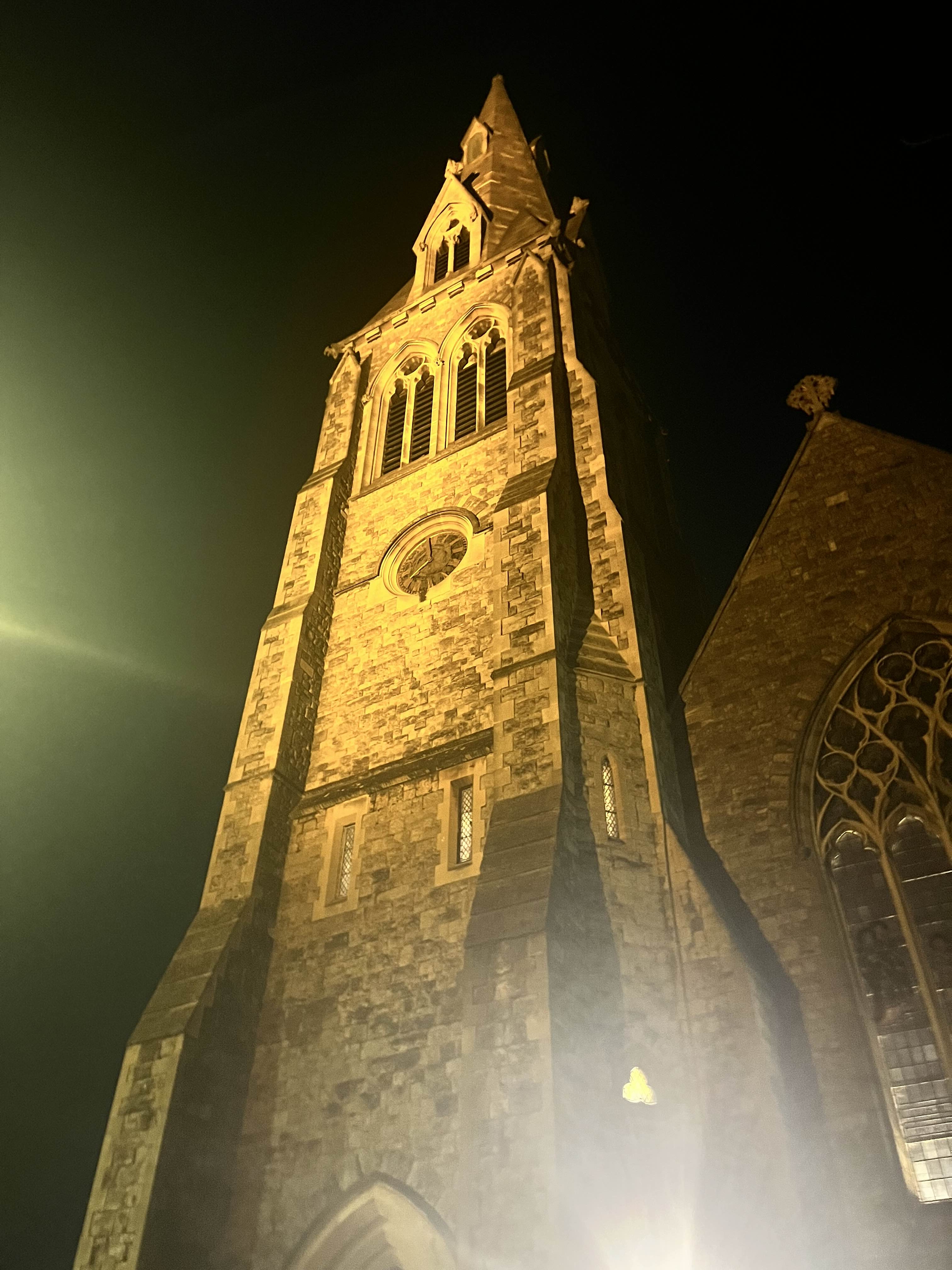
It’s a fairly substantial building (as pictured) with its clock/bell tower being quite high (unfortunately I do not know of the exact measurements however I can say… it was tall!).
Built in 1873-1888, John Beaumont gave the site for Holy Trinity. It cost £3,730 to construct. it’s quite a gothic style church. It’s faced with Kentish ragstone rubble and the pitched roofs are slate. The tower of Holy Trinity sits at the north-west corner of the building.
There is also an organ designed by Dr Bridge and built in 1889 by Father Willis.
The architect for much of the work was J. M. R Hähn (John M R Hähn) however the spire was added later in 1888 by G. Patrick. It is a Grade II listed building.
As we arrived at around 7:30pm (just before their weekly bellringing practice) we met Jonathan who is one of the bellringers of Holy Trinity and also All Saints Wandsworth which are the two churches in the parish. Unfortunately the clock mechanism at All Saints was replaced many years ago with an electric movement.
We ascended a very narrow spiral staircase on the right side of tower which lead us to an octagonal room which was the bell ringing room. There are 8 bells in the tower and the tenor (lowest bell) weighs 15 cwt (or 762 kg!). John Taylor (Bellfounder of Loughborough) cast the ring of eight bells in 1926. The tenor bears the inscription “To the Glory of God and in loving memory of Thomas Francis Harley Parkinson Lieut”
Jonathan then points us to a very steep wooden ladder to the right of the room that lead up to the clock mechanism and faces. We ascended the steps… in which they wobbled a bit, however we were assured that they were very secure (I can confirm that they were bolted at the top!). We emerged through the trapdoor into the clock room. Quite a large room, situated just above the bellringing room.
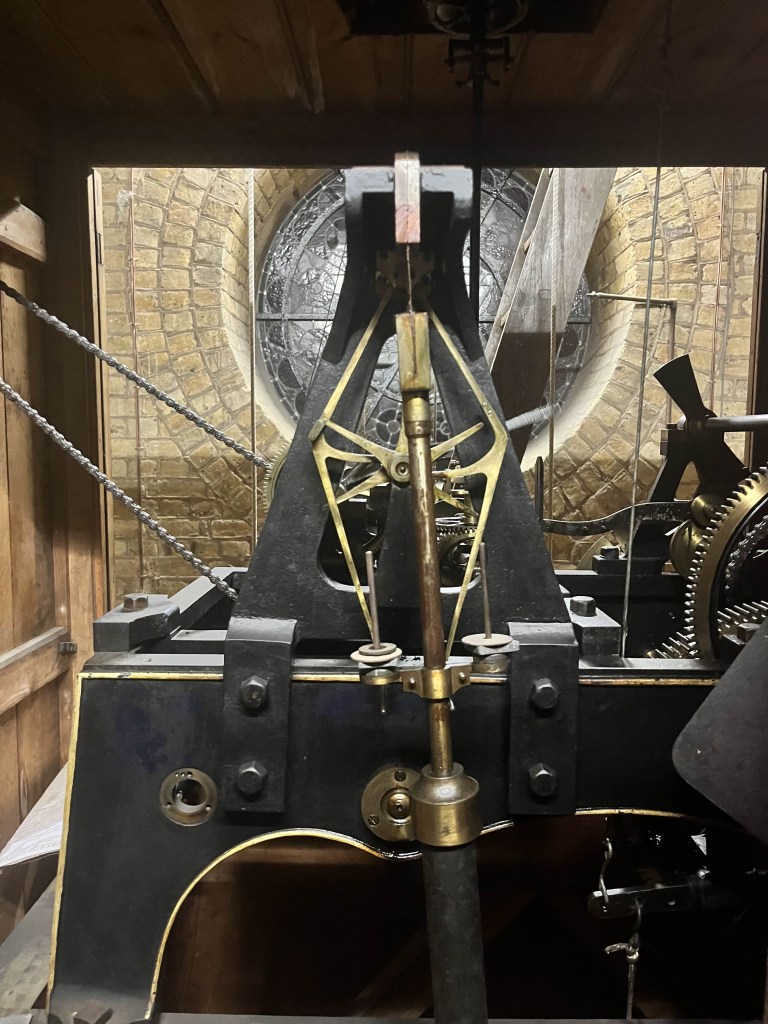
The clock has 3 dials. One facing north, one facing east and one facing west. There is no dial on the southside due to the other side of the church slightly blocking the south side however there is a circular stained glass window instead.
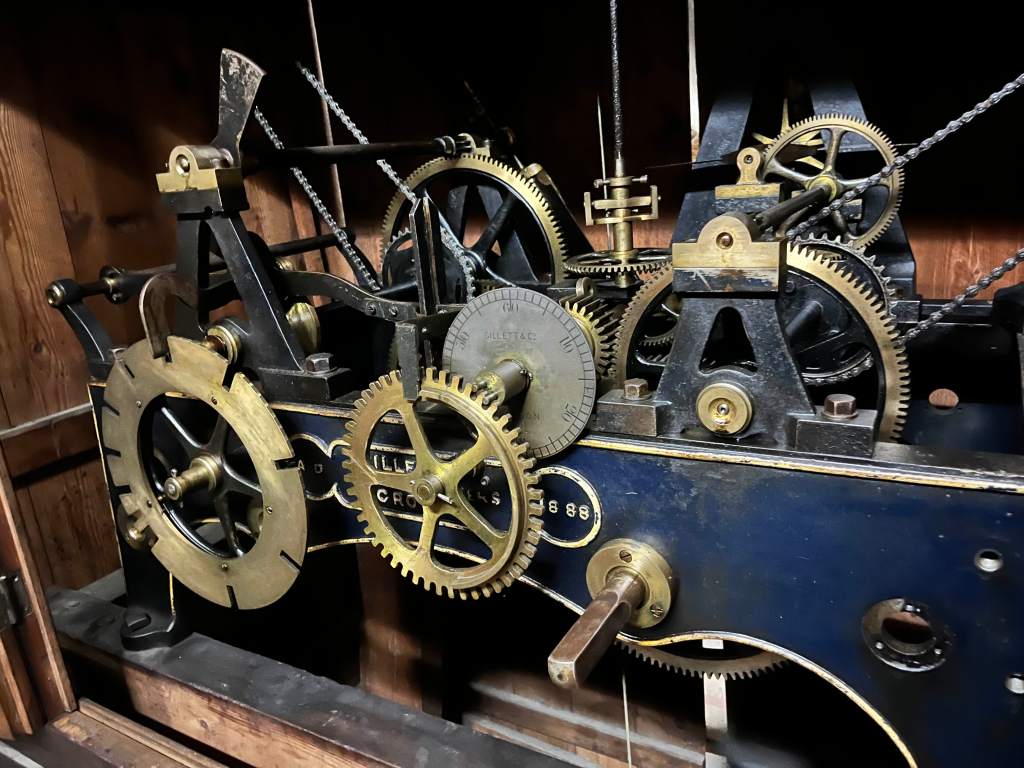
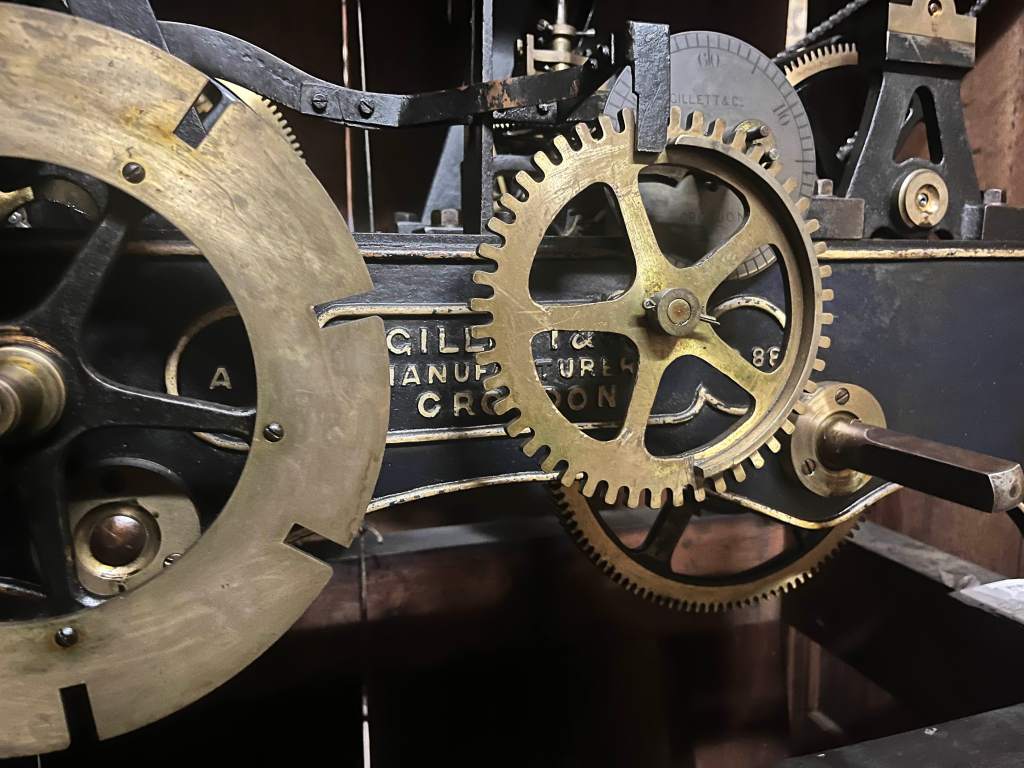
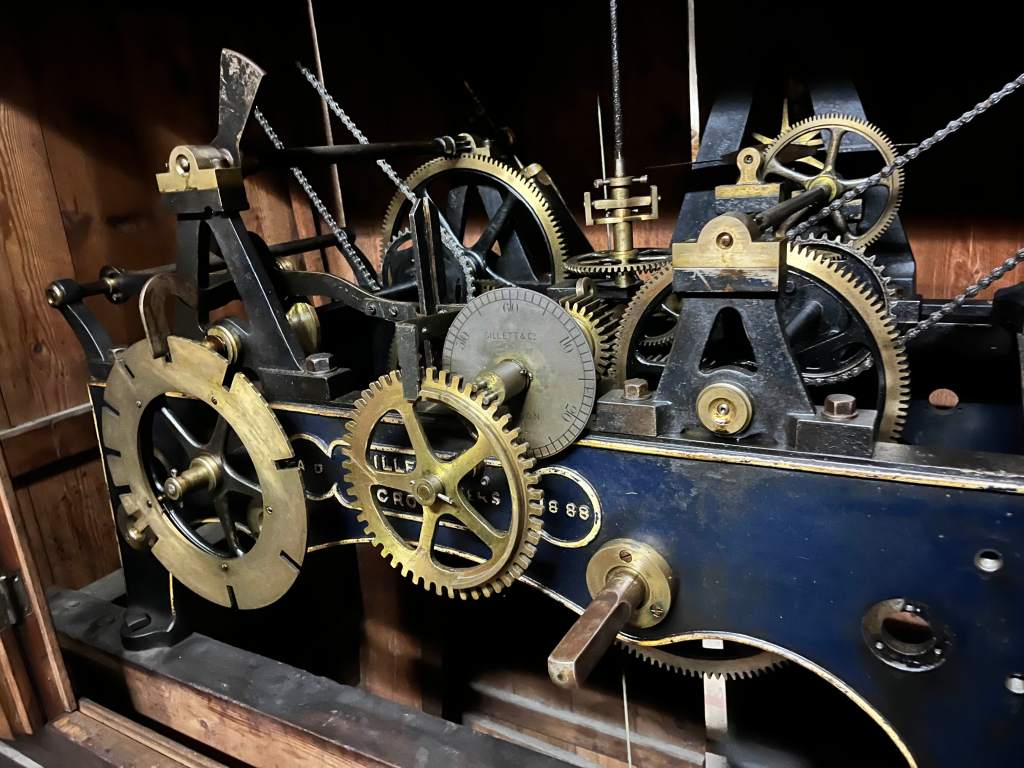
The Turret clock mechanism was made by Gillet and Johnston (however the mechanism is inscribed ‘Gillet Co, Croydon) in 1888. Jonathan told us that the clock was actually installed before the current bells (as said above, they were cast in 1926) and so they had to move the clock mechanism which stands on top of the central trap door, to lift the bells to the top of the tower.
The clock uses a Denison Double Three-Legged Gravity Escapement, the same escapement used in The Great Clock in the Houses of Parliament (Or ‘Big Ben’ if you will). I find these are quite common with Turret clocks and I suspect to see many more escapements such as this in my further adventures.
The clock has count wheel striking (as expected) however has an automatic shut off feature connected to the going train which stops the chimes from 8pm – 7am. I believe the count wheel is designed to account for the missed hours.
The clock is also wound automatically by two motors (to accommodate two trains). We were very lucky to actually catch the time weight being automatically lifted.
Please see pictures below for the clock movement.
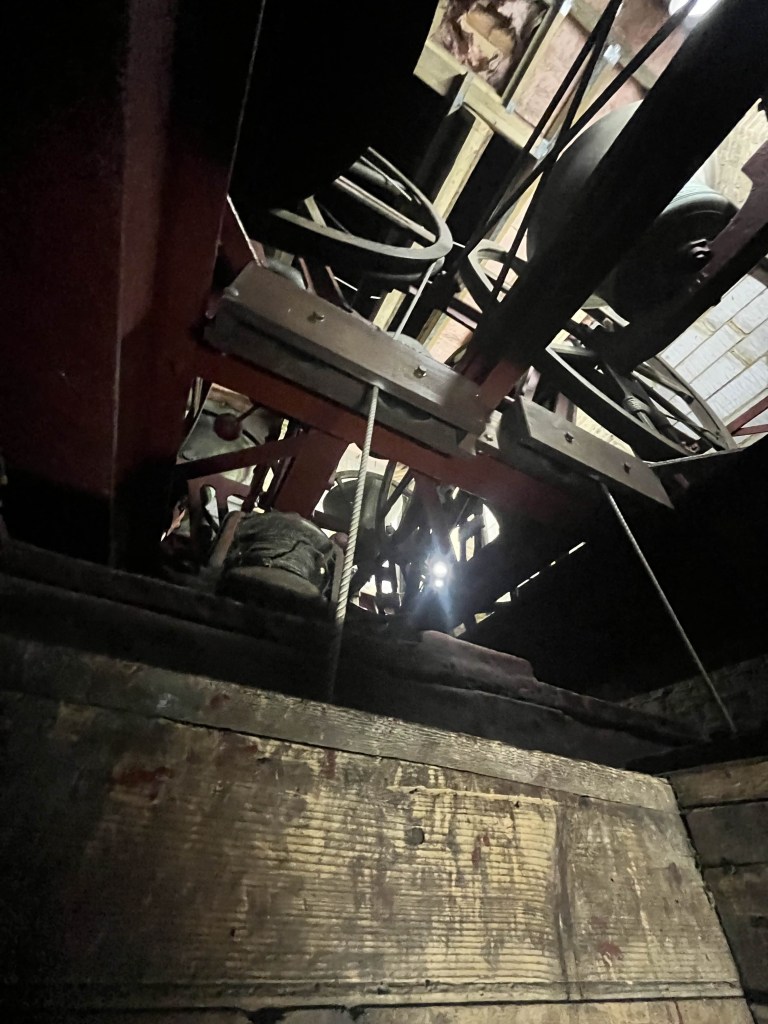
I was then asked if I would like to take a peek at the bells. Without hesitation (and also without seeing another tall wooden ladder!) I immediately said yes. I was only allowed to stick my head through the trapdoor due to the bells being turned (upside down) and if we went up there, there was a high likelihood of one of us knocking the ropes and accidentally causing them to swing around!
It was an incredibly big room, quite large in fact. It definitely looks smaller from the outside. The tenor bell is just next to the trap door opening (thankfully it was not upside down and so it was safe!). It was awesome to see so many.
As we were about to leave, Jonathan very kindly asked if we would like to have a go at bellringing. Of course I jumped at the chance, believing that me doing brief bellringing for a few weeks at six years old would be good enough! However I think I underestimated how technical it really is. Thankfully Jonathan was there to help me along the way and so it was a really cool experience!
It was nearing 8pm and so alas our time in the tower had come to end. We were very kindly invited to stay for part of the bellringing however it was getting quite dark and we unfortunately had to be home by 8:30.
It was overall a wonderful experience and visit. I very much thank Jonathan for kindly showing us the tower and its clock! As well as letting me have a go at ringing a few bells!
Thank you for reading! Until the next one!
 Clockman's Adventures!